
Tech Diplomacy News: 3rd Annual Technology Diplomacy Award Announced
| The 3rd Annual Technology Diplomacy Award Presented to Her Excellency Deemah AlYahya |
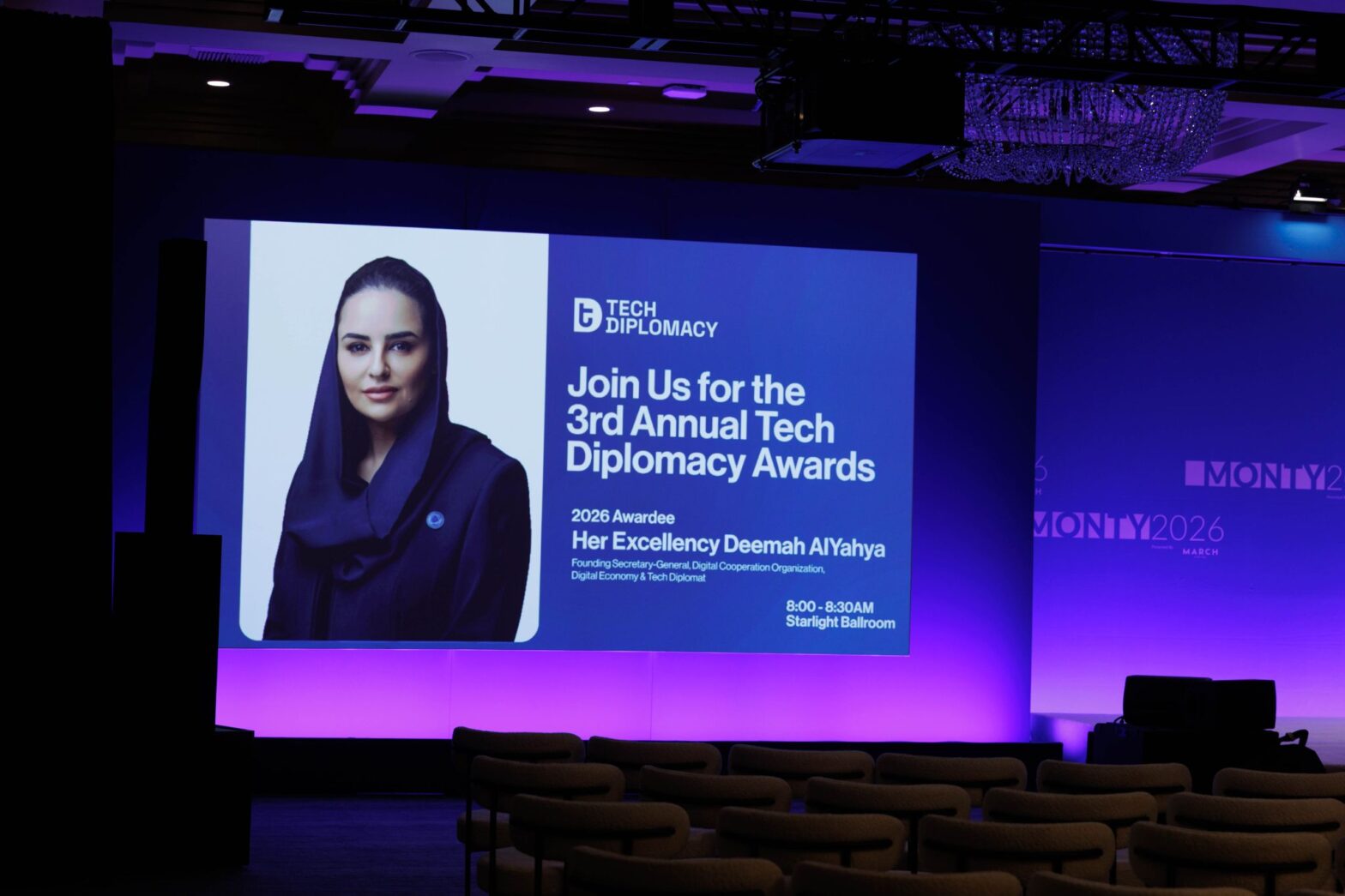
The Tech Diplomacy Network was honored to co-present the third annual Tech Diplomacy Award alongside Keith Strier Streit, SVP, Global AI Markets at AMD, to Her Excellency, Deemah AlYahya, Founding-General Secretary of the Digital Cooperation Organization (DCO). Her relentless commitment to expanding access to the benefits of digital technology and AI for people around the world is exactly the spirit this award was created to celebrate. A special thank you to Her Excellency for joining us for a fireside chat diving into the origins and impact of the DCO. This award is made possible through our partnership with The Montgomery Summit and its founder, Jamie Montgomery, an exclusive, invitation-only gathering of entrepreneurs, investors, top corporate executives, and government officials. We are proud to stand on the shoulders of our first two recipients, former U.S. Ambassador at Large for Digital Affairs Nathaniel Fick and the legendary Cisco Chairman Emeritus John Chambers, and to add Her Excellency Deemah AlYahya to that remarkable legacy. We are grateful to everyone from the diplomatic, academic, and policy space who traveled to be with us. The Summit is a profound gathering of entrepreneurs and thinkers, with conversations spanning geopolitics, the 2028 LA Olympics, the LA mayoral race, agentic AI, bio and health tech, crypto, and more. |
| News Roundup Global At the India AI Impact Summit last month, global leaders signaled a shift in focus from AI safety toward scaling adoption and real-world deployment, with growing emphasis on how countries can build “sovereign” AI capabilities. Rather than pursuing complete independence, many discussions centered on more practical approaches like diversifying partners and tailoring AI to local needs, especially across languages and public services. The U.S. used the summit to promote exporting its chips, cloud, and models as a foundation for other countries’ AI systems, while still rejecting binding global rules, even as it backed softer cooperation through the Delhi Declaration. For Brookings, Cameron F. Kerry and Elham Tabassi note the overall takeaway was that the global AI agenda is moving from risk-focused debates to competition over access and influence. Demand for critical minerals like lithium, cobalt, and nickel is set to surge as they become central to everything from clean energy to advanced weapons systems, with the United Nations warning demand could triple by 2030 and quadruple by 2040. The rapid growth is turning these resources into a core geopolitical issue, as countries race to secure supply chains and reduce reliance on dominant producers. Read the global digital policy roundup from Tech Policy Press here. North America Cyber warfare is playing a significant, yet largely undisclosed role, in the U.S.-Israel conflict with Iran, Joe Tidy reports for the BBC, with General Dan Caine, chairman of the Joint Chiefs of Staff, describing U.S. Cyber Command as the “first movers” in disrupting Iran’s ability to “see, communicate and respond” before the initial strikes. The most notable Iranian counter-attack to date has been a wiper malware strike on U.S. medical tech firm Stryker, claimed by Iran-backed hacktivist group Handala. Dr. Louise Marie Hurel from the Royal United Services Institute believes the conflict is “an opportunity for us to have a more public debate regarding the support and strategic advantage cyber provides in broader military campaigns,” arguing that openly acknowledging cyber as integral to strike packages “can help sharpen the questions about the laws of armed conflict, proportionality, and what counts as a use of force.” OpenAI is preparing for a potential IPO as early as the fourth quarter of this year, with the company pivoting its focus toward enterprise customers and high-productivity use cases ahead of its public market debut. CEO of Applications Fidji Simo told employees at an all-hands meeting earlier this month that the company is “orienting aggressively” toward turning its 900 million weekly ChatGPT users into “high-compute users” by transforming the chatbot into a workplace productivity tool. The U.S. government has declared Anthropic an “unacceptable risk” to national security, arguing the AI company could disable or alter its technology to suit its own interests rather than the country’s priorities in wartime. The dispute stems from a 200 million USD Pentagon contract that collapsed after Anthropic said it did not want its AI used for mass surveillance of Americans or with autonomous lethal weapons, prompting Defense Secretary Pete Hegseth to label the company a “supply chain risk,” a designation previously reserved for foreign firms, Sheera Frenkel reports for The New York Times. Canada and India have launched a broad strategic partnership focused on energy and tech, with plans to significantly expand trade and investment. The deal includes cooperation in AI, critical minerals, clean energy, and space, alongside major commercial agreements and joint research initiatives. Both countries are positioning the partnership to strengthen supply chains and economic resilience, reflecting a wider effort by both nations to diversify alliances and play a larger role in global tech and energy systems. Canada has ordered a safety review of OpenAI after concerns that its systems failed to flag a high-risk user linked to a recent mass shooting, and the government is now testing the company’s safeguards and pushing for stronger accountability, including better detection of dangerous behavior and faster coordination with law enforcement, Mickey Djuric reports for Politico. Donald Trump barely addressed AI in his address at the 2026 State of the Union, mentioning it mainly in passing while focusing on a pledge requiring tech companies to cover the energy costs of their data centers. He also referenced limited initiatives like legislation against AI-generated deepfakes and a student AI competition, but avoided broader issues. Critics say the approach relies too much on voluntary commitments and ignores major concerns like job losses and the need for stronger regulation, and overall, the speech suggested the administration lacks a clear, comprehensive AI strategy despite growing public pressure for stricter rules. Major tech companies, including Google, Microsoft, Amazon, Meta, and OpenAI, have agreed to cover the electricity costs of their AI data centers under a White House-backed pledge, which aims to ease concerns that rising data center demand could drive up energy bills for households and strain power grids. Companies will fund new power generation and grid upgrades, but experts warn the move may not fully solve deeper issues like slow energy infrastructure buildouts and long-term pressure on electricity systems. Watch this discussion hosted by CSIS, which unpacks the implications of China’s advancement in several high-tech sectors for the U.S. Africa Nigeria’s digital space is increasingly becoming a battleground for democracy, as internet shutdowns, surveillance, and cybercrime laws are used to restrict civic freedoms while tech platforms and weak oversight amplify misinformation and harm. A new analysis warns digital authoritarianism is tightening its grip, especially on journalists, activists, and young people, even as technology still holds the potential to expand participation and accountability. The challenge now is not just policy or platforms, but also building stronger civil society networks and public understanding: “democracy erodes quietly when people stop seeing how abstract policies affect their daily lives,” Toyin Akinniyi and Nkemdilim Ilo report for Premium Times. South Africa and the Netherlands have signed a new agreement to deepen cooperation on digital skills, AI, cybersecurity, and online child protection, a partnership aiming to expand knowledge sharing and joint technology development. Both nations characterised the deal as a way to strengthen innovation while improving online safety and resilience across digital systems. African tech leaders view the rapid rise of AI as opening new pathways for women to enter the industry, lowering traditional barriers like coding experience and expanding opportunities across sectors from healthcare to agriculture. At a recent Nairobi summit focused on women in tech, founders and policymakers highlighted growing momentum, with more women joining training programs and tech communities, but warned that persistent challenges like pay gaps and lack of visibility remain, noting access alone is not enough without stronger recognition and inclusion, Denis Mwangi reports for Business Insider Africa. Mobile communications advocacy body GMSA is bringing together operators and global organizations, including Vodafone, Airtel, the World Bank Group, and the International Telecommunication Union, amongst others, to test 40 USD smartphones in Congo, Ethiopia, Nigeria, Rwanda, Tanzania, and Uganda this year. The goal is to close the continent’s device affordability gap, which remains one of the biggest barriers to getting people online despite widespread network coverage. The initiative aims to bring tens of millions online, but past attempts in markets like India have failed due to weak performance and competition from slightly pricier but better devices. Experts say success in Africa will depend not just on hitting the price point, but ensuring phones are supported by financing and policy changes, Ananya Bhattacharya reports for Rest of World. Kenya is seeking to tighten control over AI with a proposed law that would criminalize deploying “high-risk” AI systems without government approval, targeting use cases like credit scoring, biometrics, and health diagnostics. The draft bill would introduce fines and possible jail time, while also extending liability to company executives and requiring approval before systems go live. Cabo Verde has appointed a Tech Ambassador and joined the Tech Diplomacy Global Institute, signalling a push to integrate technology into foreign policy and play a bigger role in shaping global digital governance. Asia The U.S.-Iran conflict and resulting oil shock are starting to reshape how work is organized across parts of Asia, as governments and companies scramble to cut fuel use and manage rising costs: countries like Vietnam, Pakistan, Thailand, and the Philippines are pushing remote work and energy-saving measures, while India has stepped in to regulate gas supplies and prevent shortages. The impact is already hitting workers, especially in the gig economy, where higher fuel and food costs are disrupting livelihoods and forcing businesses to scale back operations. Major tech companies are pouring massive investments into India’s AI sector, with firms like Microsoft, Amazon, and Meta committing alongside local giants like Reliance Industries and Adani Group. The push comes as India aims to position itself as a global AI power, backed by major spending on chips, and infrastructure, although the nation still faces challenges like limited private investment and gaps in its tech ecosystem. While the country has strong talent and growth potential, analysts say it is still catching up to the U.S. and China in advanced AI development, Kai Nicol-Schwarz reports for CNBC. China’s new five-year national plan, submitted to its legislature earlier this month, has dropped language referring to the “chip war,” signaling a significant strategic shift that Washington has seemingly been slow to recognize. Rather than racing to out-produce American chipmakers, Beijing is now measuring success by how deeply AI and computing infrastructure penetrate its own economy and, critically, the economies of developing nations. Most concerning for security analysts is a provision explicitly linking China’s entire civilian computing strategy, including infrastructure projects offered to partner nations as AI capacity-building, to military combat capability, meaning the same systems being deployed across the Global South are by official mandate designed to serve military modernization as well, Russ Wilcox writes for The Diplomat. Singapore and Japan have upgraded their relationship to a strategic partnership, expanding cooperation across trade, technology, security, and energy. A major focus of this partnership is on digital and emerging tech, including AI, semiconductors, cybersecurity, and quantum, alongside efforts to set rules for digital trade and data governance, and the partnership also aims to strengthen supply chain resilience, green energy collaboration, and regional security coordination. Beijing-based ByteDance has launched an internal tool called ByteClaw to manage security risks linked to emerging AI agent systems, while warning employees about threats like prompt injection and supply chain vulnerabilities. The move reflects growing concern around open-source AI agent frameworks like OpenClaw, which allow companies to build autonomous systems but introduce new security challenges. The rollout also highlights a broader race among Chinese tech firms to develop AI agent ecosystems, alongside competitors like Tencent and Alibaba. Europe The UK government has announced plans to launch the Fundamental AI Research Lab, backed by up to 40 million GBP in government funding over six years, to foster “transformational breakthroughs” in healthcare, transport, science, and public services. Rather than scaling up existing systems, the lab is tasked with rethinking how AI tools are built from the ground up to address persistent problems like unreliable memory and unpredictable reasoning. AI Minister Kanishka Narayan said the goal is to ensure “the next big AI breakthroughs are made in Britain,” with the lab serving as an early first step toward delivering UK Research and Innovation’s broader 1.6 billion GBP, four-year AI strategyannounced last month. Europe’s Chips Act is moving from policy to physical infrastructure, with the inauguration of two major semiconductor pilot lines designed to close the gap between research and industrial manufacturing. Both lines operate as open-access facilities for SMEs, startups, and academic institutions across the EU, addressing what policymakers describe as Europe’s core structural weakness: turning world-class research into manufacturable chips, Neil Tyler writes for New Electronics. Slovenian Prime Minister Robert Golob has launched an investigation into allegations that a foreign spy-for-hire network may have tried to influence voters, after media reports linked opposition leader Janez Janša and his SDS party to a smear campaign involving Israeli firm Black Cube. The controversy centers on secretly recorded conversations released earlier this month, in which political and legal figures allegedly discussed influence-peddling and covert funding, though those involved say the footage was manipulated. Golob called the affair potentially “the biggest scandal in Slovenia’s history,” and warned it could amount to “high treason,” while officials say any role by foreign intelligence actors during an election “could constitute a threat for national security,” Elisa Braun reports for Euractiv. Poland is planning to ban mobile phone use for students under 16 in schools starting in September, as part of a broader push to curb screen time and reduce dependence on digital platforms among children. The move would align Poland with countries like the Netherlands, Italy, and South Korea that have already introduced similar restrictions, with officials arguing that constant phone use is harming concentration and behavior in classrooms. Meta is facing new scrutiny in the U.K. after regulators found the company repeatedly failed to block illegal financial ads, despite earlier commitments to crack down on scams. A review by the Financial Conduct Authority uncovered more than 1k unauthorized ads for high-risk investment products in just one week, with over half coming from advertisers already flagged to the platform. The findings highlight a regulatory gap, as current laws limit authorities’ ability to penalize platforms for paid scam ads, leaving enforcement largely dependent on voluntary compliance, Phoebe Seers, Tommy Reggiori Wilkes, and Jeff Horwitz report for Reuters. A new cross-border investigation from the Organized Crime and Corruption Reporting Project has uncovered far-right connections to a German-language outlet pushing pro-Kremlin and anti-Western narratives, shady donations, and amplification by accounts potentially tied to Russia’s security service, underscoring how disinformation operations are built not just on false stories, but on networks designed to erode trust in politics and the media across Europe. Last month, the European Commission delayed key guidance on what qualifies as “high-risk” AI under the EU AI Act, marking a second missed deadline and adding to growing uncertainty around how the rules will actually be enforced. The guidance is meant to clarify which systems face stricter requirements like risk management and human oversight, but officials say more time is needed to process feedback from stakeholders. The delay also highlights broader rollout challenges, as several EU countries have yet to appoint regulators to oversee compliance, raising concerns about how quickly the bloc can move from legislation to real enforcement. Latin America The 2026 FIFA World Cup is expected to sharply increase Mexico’s exposure to AI-facilitated cyberattacks, as surging tourism and data flows increase vulnerabilities across industries from banking to logistics. Experts warn cybercriminals are already using generative AI to launch more convincing phishing scams and fake streaming platforms, targeting fans and businesses during the event: Arturo Torres, Director of Threat Intelligence for FortiGuard Labs, noted that for attackers, an event like the World Cup is “a maximum opportunity for success,” Diego Valverde reports for Mexico Business News. A novel political experiment in Colombia is testing how AI could reshape democratic representation, with an AI avatar named “Gaitana” acting as the digital face of two Indigenous candidates who have pledged to let a community-driven online platform determine how they vote on legislation if elected. However, the project raises major concerns, including limited internet access in rural Indigenous areas potentially causing exclusion, and risks tied to platform control, bias in AI systems, and cybersecurity. Recent data from IBM shows Latin America now accounts for about 9% of global cyberattacks, with AI-facilitated threats, credential theft, and supply chain vulnerabilities driving the increase. Attackers are increasingly relying on automation and existing tools inside corporate systems to evade detection, while also targeting older, unpatched software rather than more complex zero-day exploits. LatamGPT, a regional effort led by Chile to build an open-source AI model trained on Latin American data, is being framed as a push for tech sovereignty, but faces steep challenges competing with global AI giants from the U.S. and China. Backed by 15 countries and built on localized datasets, the project aims to address gaps in representation and enable applications tailored to regional needs, from education to public services, but limited funding and political instability raise questions about long-term viability, Ezequiel Rivero writes for Tech Policy Press. Brazil is rolling out a new law aimed at strengthening child protection online, giving regulators the power to fine tech companies millions or even suspend platforms if they fail to comply. The legislation introduces stricter rules around aspects like age verification, content moderation, and platform design, including limits on features that encourage excessive use among children. While the law reflects a broader global push to hold platforms more accountable, its impact will depend on enforcement, with regulators facing capacity constraints and a tight timeline to implement the new rules. Costa Rica has opened a new investment office in Silicon Valley as part of a broader push to attract global tech companies and position itself as a regional hub for high-value industries. The office will focus on sectors like software, tourism, semiconductors, and business services, while promoting the country’s stability, skilled workforce, and sustainability credentials to investors. Oceania Australia is trying to position itself as a key player in global critical minerals supply chains, but rising geopolitical competition and domestic constraints are complicating that ambition, Ian Satchwell writes for the Australian Strategic Policy Institute. While demand is growing due to an energy transition, AI, and defense needs, challenges like high costs and fragmented policies among allies are limiting how much of the advantage Australia can capture, requiring a look at the nation’s strategy for long-term success. Australia’s intelligence relationship with the U.S. remains central to its national security, but growing unpredictability in Washington is starting to strain long-standing alliances like Five Eyes. New analysis warns shifting U.S. policies under the Trump administration are creating uncertainty, with disruptions in intelligence sharing raising concerns about trust and coordination among allies. When finished, American Samoa’s subsea fiber-optic cable, “Le Vasa,” aims to reduce dependence on a single existing line and improve network resilience. The 45 million USD project, supported in part by U.S. funding and built with Google, will be owned and operated locally, seeking to expand reliable internet access and enable services like telehealth and remote education, alongside digital business growth. New Zealand’s intelligence agency has warned that parts of the country’s critical infrastructure have weak cybersecurity, with some systems barely meeting basic standards as threats rapidly increase. The government is now rolling out a new strategy and reforms to catch up with other Five Eyes partners, focusing on protecting key sectors and tightening expectations on businesses, with officials also flagging supply chains and private companies as major vulnerabilities, particularly as AI is making cyberattacks more frequent and sophisticated, Phil Pennington reports for RNZ. Australia’s current approach to AI safety is being criticized as weak and fragmented, relying largely on existing laws rather than introducing new, AI-specific regulation, with experts warning that existing legal frameworks struggle to handle AI’s complexity, leaving gaps in accountability and risk management. Compared to regions like the EU, Australia’s “wait and see” approach creates uncertainty, José-Miguel Belloy Villarino and Henry Fraser write for The Conversation. |
Follow our LinkedIn page to keep up to date on our upcoming events, publications, and efforts to foster collaboration and dialogue between the diplomatic community, civil society, and the tech industry. For more updates, stay tuned to the Tech Diplomacy Network! |