
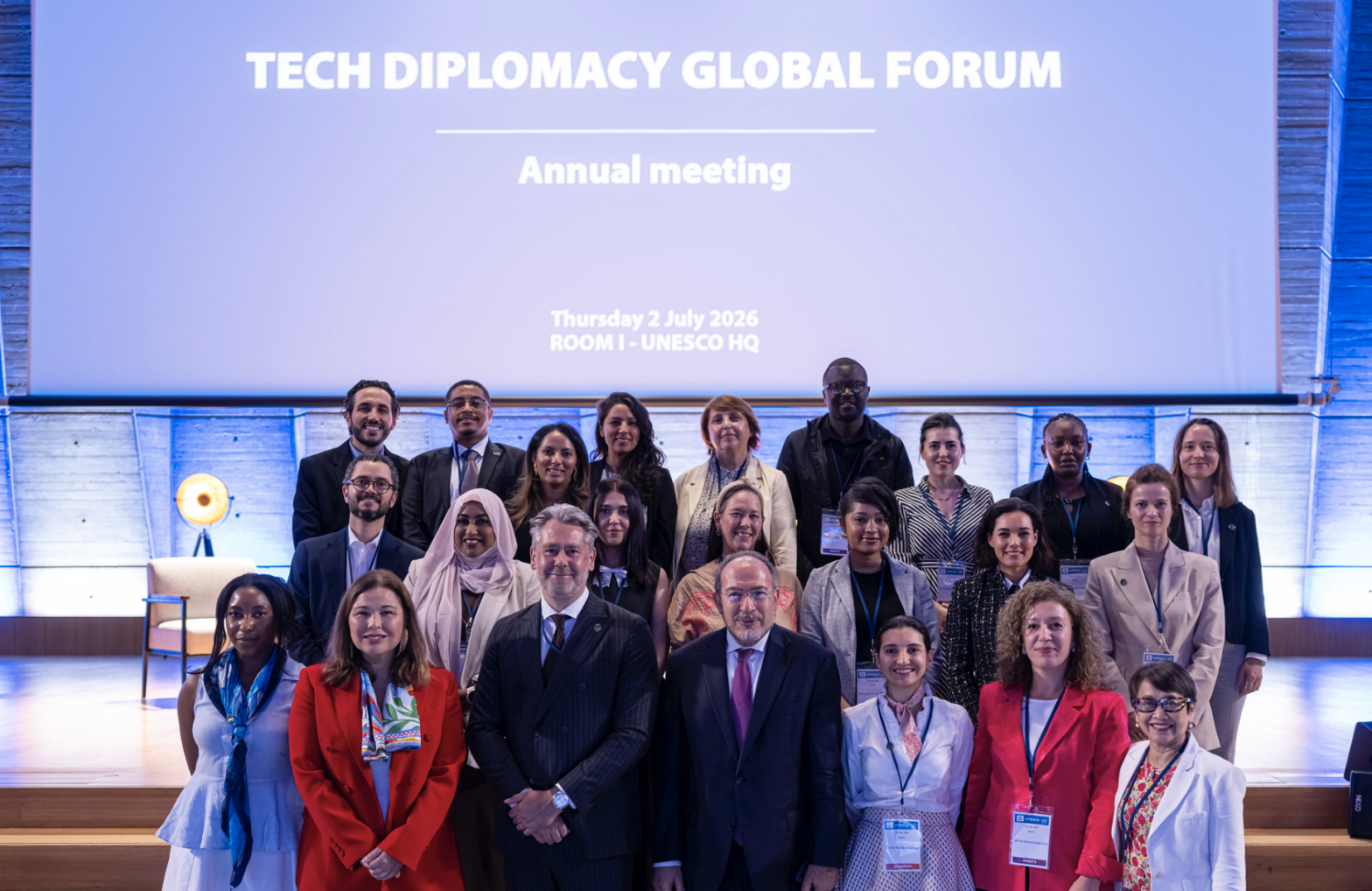
Tech Diplomacy News: second Tech Diplomacy Global Forum successfully concludes
| The second Tech Diplomacy Global Forum concluded July 2 at UNESCO Headquarters in Paris, convening Ministers, Ambassadors, senior officials, technology leaders, and scholars from across the globe under the theme “Tech Diplomacy as Statecraft: Building Trust in a Fragmented Era.” More than 1,000 participants attended in person, with thousands more following online, as speakers from over 30 countries addressed the growing gap between the pace of technological change and the capacity of institutions to govern it. The Tech Diplomacy Network was pleased to be a partner and to take part in this year’s discussions, with co-founder Martin Rauchbauer and president Christina Steinbrecher-Pfandt joining panels on the future of digital cooperation. We look forward to continuing to work alongside the Institute, UNESCO and our fellow partners in the months ahead, and thank all who helped make this year’s Forum possible. News Roundup Global At the UN’s inaugural Global Dialogue on AI Governance in Geneva earlier this month, Secretary-General António Guterres called for sweeping global rules on AI, covering military “killer robots,” child safety, human rights, and environmental transparency, ultimately warning that without coordinated approaches, AI risks deepening global inequality and causing serious harm. Twenty-nine countries formalized a World AI Cooperation Organization headquartered in Shanghai, positioning China’s governance framework as a counterweight to U.S.-led initiatives as Beijing races to establish itself as a democratic alternative for AI development. Founding members include Russia, Belarus, Cuba, Venezuela, Brazil, and representatives from ten African and twelve Asian nations, a coalition that reflects Beijing’s strategy to build influence among countries frustrated by American technology restrictions. The UN’s Independent International Scientific Panel on AI is caught in a contradiction, warning against dangerous AI concentration among a handful of corporations and countries, yet simultaneously promoting rapid global AI diffusion that depends on private sector investment and infrastructure controlled by those same Big Tech giants. According to Bradley McNeil, writing for Tech Policy Press, “the global diffusion of AI technologies and challenging AI market concentration are fundamentally different governance objectives,” as the UN becomes “increasingly willing to critique the political economy of AI development” but “reluctant to advocate for structural reforms that would challenge existing distributions of technological and economic power.” Australia, Canada and India have formalized the Australia-Canada-India Technology and Innovation Partnership through a memorandum of understanding, establishing a joint working group to collaborate on AI adoption, startup ecosystems, policy alignment, and risk mitigation across the three nations. The agreement extends beyond AI to encompass digital infrastructure, semiconductors, and cybersecurity as the nations seek closer technology ties independent of larger powers. Read the June global digital policy roundup from Tech Policy Press here. North America Canada has enacted the Protecting Victims Act, strengthening criminal penalties for sexual offences, sextortion, non-consensual intimate image sharing, and AI-generated sexual deepfakes while equipping authorities with enhanced cross-border enforcement powers and expanded investigative timeframes. The law requires internet service providers to retain data longer and introduces a new criminal offence targeting the recruitment of minors into criminal activity. The reforms reflect a global policy shift toward digital-age child protection frameworks, as governments struggle to keep legal systems aligned with technology-enabled harms that operate across international networks. The U.S. and China will hold their first official AI dialogue under President Trump in September, with Treasury Secretary Scott Bessent leading the U.S. delegation. The talks stem from the Trump-Xi summit in May and aim to address risks from each country’s advanced AI models, including military applications, cyberattack potential, and labor market disruption. Bessent has flagged concerns about Chinese models allegedly copying U.S. large language models, and analysts expect the initial meeting to yield only basic groundwork rather than resolving major disputes. OpenAI is restricting access to its new GPT-5.6 Sol model to customers approved by the Trump administration, while Anthropic secured partial clearance for its Mythos 5 model after it was effectively banned weeks earlier. These moves follow Trump’s June executive order establishing a 30-day national security review process for frontier AI systems, driven by concerns that models like Anthropic’s Mythos can autonomously identify software vulnerabilities in ways that could be weaponized by malicious actors targeting critical infrastructure. Critics are warning “that unpredictable government intervention can hold back US companies,” Matt O’Brien reports for the Associated Press. Meta is building its first major Canadian data center, a 9 billion USD, 1-gigawatt facility in Alberta, taking two to three years to complete. Alberta was chosen for its abundant energy supply and favorable regulations, and Meta is also weighing a new cloud computing business that could sell excess capacity to third parties. The move comes amid investor skepticism over Meta’s roughly 145 billion USD in planned capital spending this year, especially since the company trails other industry leaders without a clear revenue path beyond advertising. Local concerns over local environmental impacts remain, such as those related to emissions and water use. The Trump administration loosened export restrictions on advanced U.S. technology to the UAE earlier this month despite internal Commerce Department warnings from last fall flagging security risks tied to G42, the UAE’s state-backed AI company. The new policy expands beyond earlier approval for G42 to buy Nvidia chips, now granting streamlined access to military, satellite, and nuclear-related goods, a move critics say could let sensitive American tech reach China through the UAE. Commerce officials defended the decision as recognition of the UAE’s strategic alliance, but lawmakers have raised conflict-of-interest concerns, pointing to a UAE-linked 500 million USD stake in Trump’s crypto venture shortly before the policy shift. Twenty-five U.S. lawmakers, predominantly Republicans, have urged President Trump to launch trade investigations and threaten tariffs against the EU over its Digital Markets Act, arguing that Brussels is using tech regulation as a tool to unfairly target American companies while giving Chinese competitors like Temu and AliExpress preferential treatment. The lawmakers specifically objected to the likely inclusion of Amazon and Microsoft’s cloud units under the DMA, claiming such designations “would impose unprecedented regulatory burdens that European and Chinese cloud competitors would not face.” The European Commission pushed back, with spokesperson Thomas Regnier stating the bloc “has the sovereign right to regulate economic activities on its territory” and will “keep enforcing our rules in a fair and non-discriminatory manner,” Foo Yun Chee reports for Reuters. Africa Mozambique has strengthened its cybersecurity governance framework with the adoption of a new Cyber Security Act that establishes the National Cyber Security Council as a strategic coordination body, and designates the National Institute of Information and Communication Technology as the National Cyber Security Authority. The legislation introduces mandatory incident reporting, a National Cybersecurity Network linking public and private sectors, and a dedicated cyber security fund for strategic investments. Amazon announced it will launch its Amazon Leo satellite internet service in South Africa in 2027 through a partnership with local provider Herotel, marking its first satellite internet deal on the African continent and putting it ahead of Elon Musk’s Starlink in the country following the CEO’s public clashes with the South African government. Nigeria is accelerating development of domestic drone technology to reduce reliance on foreign military systems and strengthen operations against insurgent groups, with local company UNICCON building surveillance, reconnaissance, and attack platforms tailored to Nigeria’s operational environment. The military has emphasized that drones now play a “central role in operations against insurgents,” while engineers are simultaneously developing counter-drone detection and neutralization systems to address threats from hostile aerial platforms, Amaka Okoye reports for DW. Kenya has equipped 280 diplomats with training on the secure use of generative AI, with special envoy on technology Philip Thigo emphasizing that while the tech can “support research, drafting, translation, scenario analysis and communication,” diplomats must maintain strict guardrails around classified material. The move signals Kenya’s recognition that technology literacy is now essential to protecting national interests as the country advances its tech diplomacy agenda, Maria Macharia reports for ITWeb Africa. The Trump administration is tying healthcare funding to data access across Africa, offering countries like Kenya 1.6 billion USD over five years in exchange for transfers of health data to the U.S. However, strategy experts are concerned over a “recolonisation of our health system,” reflecting Washington’s race with China to secure high-quality training datasets for AI development. Since December 2025, the U.S. has signed roughly 20.6 billion USD in memorandums of understanding with twenty-one African nations, though Ghana, South Africa, Zambia, and Zimbabwe have resisted, citing sovereignty concerns and lack of reciprocity. Experts fear agreeing nations are surrendering valuable data with no guarantee they’ll access resulting innovations, while only 2% of global AI training data currently comes from Africa, meaning AI models continue to fail in accounting for African languages, names and health contexts. Uganda is leveraging global investor interest to unlock its startup potential, as East African tech companies are facing an urgent employment crisis. Legacy Hills Investments plans to launch Uganda’s first institutional venture capital fund drawing from pension schemes and family offices, addressing the financing gap that has forced founders to rely on personal savings or grants, with breakthrough sectors demonstrating investor-ready infrastructure if capital availability can catch up, according to CEO Sharon Tumushabe. For the Carnegie Endowment for International Peace, Jane Munga argues the U.S. should pursue a Technology Prosperity Deal with Kenya as a template for structured AI partnerships across Africa, as while Washington has signed such reciprocal tech-cooperation agreements with the UK, Japan, South Korea, and Sweden, no African country has one despite China’s deep footprint through initiatives like the Belt and Road and billions in Forum on China-Africa Cooperation pledges. Asia Indonesia is preparing to embed AI into major government programmes between 2026 and 2029, but experts caution that infrastructure gaps and uneven technological capacity could undermine implementation, particularly as the government seeks to address risks like “biometric misuse, intellectual property violations and deepfakes,” says this update from the Digital Watch Observatory. Saudi Arabia and the UAE are spending tens of billions to build AI dominance, yet neither can escape Nvidia’s gravitational pull despite deals with AMD, Groq, and Qualcomm meant to diversify their supply chains. The Gulf states, despite their wealth and strategic advantages, are recognizing that “true technological sovereignty in artificial intelligence is extraordinarily expensive and, for nearly every country outside the United States and China,” which is “effectively unattainable,” according to Middle East Institute senior fellow Mohammed Soliman, Indranil Ghosh reports for Rest of World. Big tech’s ties to Israel’s military operations in Gaza are drawing increasing scrutiny, with Microsoft standing out after commissioning an external investigation that confirmed the Israeli Ministry of Defense used its Azure cloud and AI tools, though the probe didn’t clarify exactly how the technology was applied. Companies like Google and Amazon, jointly running the 1.2 billion USD Project Nimbus cloud contract with Israel, face similar accusations from critics and former staff that their infrastructure supports mass data collection on Palestinians, claims both firms have downplayed or declined to fully address. Advocates argue Microsoft’s inquiry sets a new bar for accountability that other firms will now be pressured to match, even as they note the response came only after public exposure rather than proactive oversight. India is pressuring WhatsApp to address its new username feature, arguing that pseudonymous accounts could enable fraud and impersonation, a rare instance where a government is objecting to a design feature before any documented harm has occurred. WhatsApp already has 850 million users in India, giving the government significant leverage, though security experts counter that the company has built multiple safeguards including reserved names for public figures, username keys, and detection systems for impersonation patterns. If WhatsApp capitulates, experts warn it could set a dangerous global precedent, highlighting a “slippery slope” where governments incrementally pressure tech companies to fragment privacy protections across markets, Ananya Bhattacharya reports for Rest of World. Chinese President Xi Jinping used Shanghai’s annual World AI Conference to position Beijing as a champion of AI democratization, calling for global cooperation and announcing an expansion of AI partnerships with ASEAN, the African Union, Arab League and BRICS nations, while criticizing what he termed the “overstretching” of national security concerns by countries restricting technology access. At the AI for Good Global Summit in Geneva, Singapore’s Minister Josephine Teo outlined the country’s approach to scaling AI, highlighting the targeting of manufacturing, healthcare, finance, and connectivity while stressing that expanding AI use must go hand-in-hand with building public trust and safeguarding critical systems. India and Japan have issued a joint statement affirming deeper collaboration on AI, agreeing to build safe, trustworthy, and inclusive AI systems and committing to joint work on AI governance, cybersecurity, resilient tech infrastructure, supply chains, and expanded research partnerships. Europe Nigel Farage has been reported to Parliament’s standards watchdog over allegations he lobbied Bank of England governor Andrew Bailey to abandon plans for a digital pound, a move that could financially benefit Christopher Harborne, the billionaire who has donated roughly 20 million GBP to Farage and Reform UK. Labour member Phil Brickell filed the complaint, arguing Farage’s public and private opposition to the “Britcoin” plan aligns suspiciously with Harborne’s investments in stablecoin company Tether, which stood to gain from weakened central bank digital currency competition. The case adds to an existing probe into whether Farage should have declared a separate 5 million GBP personal gift from Harborne, with parliamentary rules requiring lobbying activity to be scrutinized for a year after any financial “reward or consideration” is received, Rowena Mason and Tom Burgis report for The Guardian. The Council of Europe and Cyprus’s ICT Academy convened a regional conference in Nicosia late last month, bringing together data protection and AI governance officials from across the Southern Mediterranean and Europe under the EU-Council of Europe South Programme VI. Discussions covered national and international developments in AI governance and personal data protection, framed as advancing UN Sustainable Development Goals and the EU’s Pact for the Mediterranean. EU digital chief Henna Virkkunen warned that dependence on foreign AI infrastructure is becoming a geopolitical vulnerability, pointing to the U.S.’s brief June 2026 export controls on Anthropic’s leading models as proof that access to frontier AI can be cut off by political decisions, even if later reversed. The concern feeds into Europe’s broader tech-sovereignty push, formalized in the Commission’s Cloud and AI Development Act, which flags overreliance on non-EU cloud providers as a risk to digital autonomy. The European Commission unveiled a new plan this month to tackle risks and benefits that advanced AI poses for cybersecurity, aiming to unite EU nations and institutions against threats like AI-automated attacks and other cyber incidents. Key measures include building EU capacity to independently evaluate advanced AI models under the AI Act and developing a blueprint with the EU Agency for Cybersecurity so organizations can safely use frontier AI systems, as well as creating a secure testing platform with the Joint Research Centre to simulate AI use in critical sectors. The plan also pushes critical infrastructure operators to adopt stronger cyber hygiene and use AI to patch vulnerabilities faster, while committing to scale Europe’s own AI capabilities. Google was fined 890 million EUR this week for violating the Digital Markets Act, after it was found the U.S.-based tech multinational unfairly favored its own services at the top of search results while burying competitors, and restricted app developers on Google Play from directing users to cheaper payment options. Google now has 60 days to make changes, like boosting rivals’ visibility, or faces additional penalties of up to 5% of global revenue. The timing is notable given rising trans-Atlantic trade tensions, with President Trump weighing new tariffs on the EU and having previously threatened retaliation over what he calls unfair targeting of American tech firms, though an EU official said the decision’s timing wasn’t influenced by U.S. trade developments. The penalty adds to a decade of EU fines against Google exceeding 10 billion EUR, alongside separate EU actions ordering Google to ease AI-related Android restrictions and requiring Meta to redesign Instagram and Facebook to be less addictive. Portugal launched Amália earlier this month, its first open large language model in European Portuguese, drawing on the existing open-source EuroLLM-9B model rather than training from scratch to keep costs low. The project follows a pattern already used elsewhere in Europe, including Spain’s ALIA, the Basque Country’s Latxa, and Germany’s Teuken-7B, all built through public funding, university partnerships, and shared EuroHPC computing infrastructure rather than massive from-scratch training runs. France’s parliament has approved a law banning social media for under-15s starting in January 2027, making it the first European country to enforce such a block. The rollout will begin in September when new accounts will require age verification, followed by mandatory checks on all existing accounts by January 2027. President Macron championed the law as a signature achievement before leaving office, though critics have raised concerns about privacy risks and how quickly the legislation was pushed through. Latin America After deadly earthquakes killed thousands of people in Venezuela, citizen and diaspora developers used AI tools like Claude Opus and Replit to rapidly build disaster-relief platforms, while the interim government’s response lagged. Examples include efforts to find missing persons, coordinate donations, map hospital capacity, verify survivor data, and monitor for human trafficking risks. Experts caution that while AI can meaningfully speed up crisis response, it shouldn’t replace state accountability, and stress that data privacy safeguards need to be even stronger during emergencies. ByteDance is investing roughly 39 billion USD to build Latin America’s largest data center campus in Brazil, with plans to scale from 200 megawatt to nearly 1 gigawatt of capacity by 2027, designed exclusively to serve TikTok’s operations in markets outside China, the U.S., Europe, and Brazil itself. The project dwarfs typical Latin American data center campuses, indicating ByteDance’s aggressive push to build regional infrastructure independent of U.S. and Chinese systems. The U.S. AI infrastructure boom has unexpectedly boosted Mexico’s tech exports, complicating President Trump’s push to shrink the trade deficit. Computer equipment, driven largely by demand for server racks housing AI processing cards, tripled year-over-year between January and April, surpassing 50 billion USD and overtaking automobiles as Mexico’s top export category to the U.S. Despite the sector’s strategic importance to U.S. AI development, experts warn it could still become a tariff target, particularly since many Mexican manufacturers rely on Chinese and Taiwanese components that Trump’s administration might view as a security backdoor for Asian technology. Argentina’s government has proposed a bill creating a “non-human corporation” category, letting AI agents or robots own and run a company without requiring human shareholders, as part of President Javier Milei’s push to attract AI investment to Buenos Aires alongside a low corporate tax rate. Latin America is increasingly pushing for space sovereignty, using Brazil’s recent approval of China’s SpaceSail satellite network, seen as a Starlink alternative, as a symbol of the region’s desire for more options. Full space independence is unrealistic given the sector’s inherently global, interdependent nature, Laura Delgado López argues for Americas Quarterly, warning countries chasing standalone capabilities without complementary systems like ground infrastructure and data processing risk merely relocating vulnerability rather than reducing it. Taiwan is deepening technology cooperation with Latin American nations as digital infrastructure becomes a national security priority, exemplified by Paraguay’s agreement with the nation to build an AI data center and Taiwanese support for Guatemala’s cybersecurity operations. These partnerships, along with support from other nations like the U.S., are part of a broader push for “trusted technology” that reduces reliance on foreign, and particularly Chinese, digital infrastructure, Julieta Pelcastre writes for Diálogo Americas. Oceania At the 2026 Pacific Peace and Security Dialogue last month, regional leaders discussed how rapidly spreading AI and digital technology bring both opportunity and risk to Pacific communities, with Kiribati Minister Ruth Cross Kwansing noting that “the threat and the solution are sitting in pretty much the same device.” Australia’s Cyber Ambassador Jessica Hunter outlined Australia’s strategy of prevention, protection, and systemic change, including its pioneering under-16 social media restriction aimed at pushing companies toward stronger safety standards. Papua New Guinea’s Media Council President Neville Choi argued the region needs to develop its own AI tools grounded in Pacific languages and culture rather than relying solely on frontier models built by larger countries, framing this as an opportunity for the Pacific to “play by our own rules” rather than importing external frameworks, a media release from the Pacific Security College shares. Leaders of the Five Eyes cybersecurity agencies, including New Zealand’s National Cyber Security Centre, issued a joint call to action warning that frontier AI is rapidly reshaping cyber risk by helping malicious actors discover and exploit vulnerabilities faster than ever, narrowing the window organizations have to respond before an attack occurs. NCSC Deputy Director General Catriona Robinson urged organizations to assess their risk and readiness and empower cyber leaders with real authority and resources, stressing that breaches are inevitable but preparedness determines whether they escalate into major crises. She noted New Zealand’s NCSC is directly accessing frontier AI models and working with providers to better understand their security implications, while also developing guidance for local businesses and ensuring cybersecurity is built into government digital projects from the outset. Australia’s federal health department has flagged growing concerns over AI scribe tools, which record and transcribe doctor-patient conversations, as usage among general practitioners nearly doubled from 22% to 40% between August 2024 and November 2025. Officials warned the tools “have little oversight,” noting some are marketed as exempt from medical device regulation or as privacy-compliant despite limited transparency, with some suppliers reportedly unaware their cloud platforms transmit patient data overseas. The Therapeutic Goods Administration is currently reviewing whether these tools should be formally classified as medical devices, with findings expected in the coming months, while Australia’s privacy commissioner said her office is actively monitoring the rollout, Josh Taylor reports for The Guardian. Australian Prime Minister Anthony Albanese confirmed Australia will contribute 145 million FJD to Fiji’s digital transformation through a new Pacific Australia Skills Program. The initiative will establish technical and vocational education Centres of Excellence in Suva aimed at building workforce skills for Fiji’s economy and supporting its ambitions to become a regional digital hub, building on a program that has already helped thousands of Fijians gain qualifications over the past two decades. A new report from the Australian Strategic Policy Institute assesses how Australia’s National Intelligence Community is falling behind, because while intelligence collection and analysis have modernized, products haven’t kept pace with what ministers and policymakers now expect from an AI-shaped information environment. |
Follow our LinkedIn page to keep up to date on our upcoming events, publications, and efforts to foster collaboration and dialogue between the diplomatic community, civil society, and the tech industry. For more updates, stay tuned to the Tech Diplomacy Network! |