
Tech Diplomacy News: leaders recognized in Tech Diplomacy Global 50 list
| News Roundup |
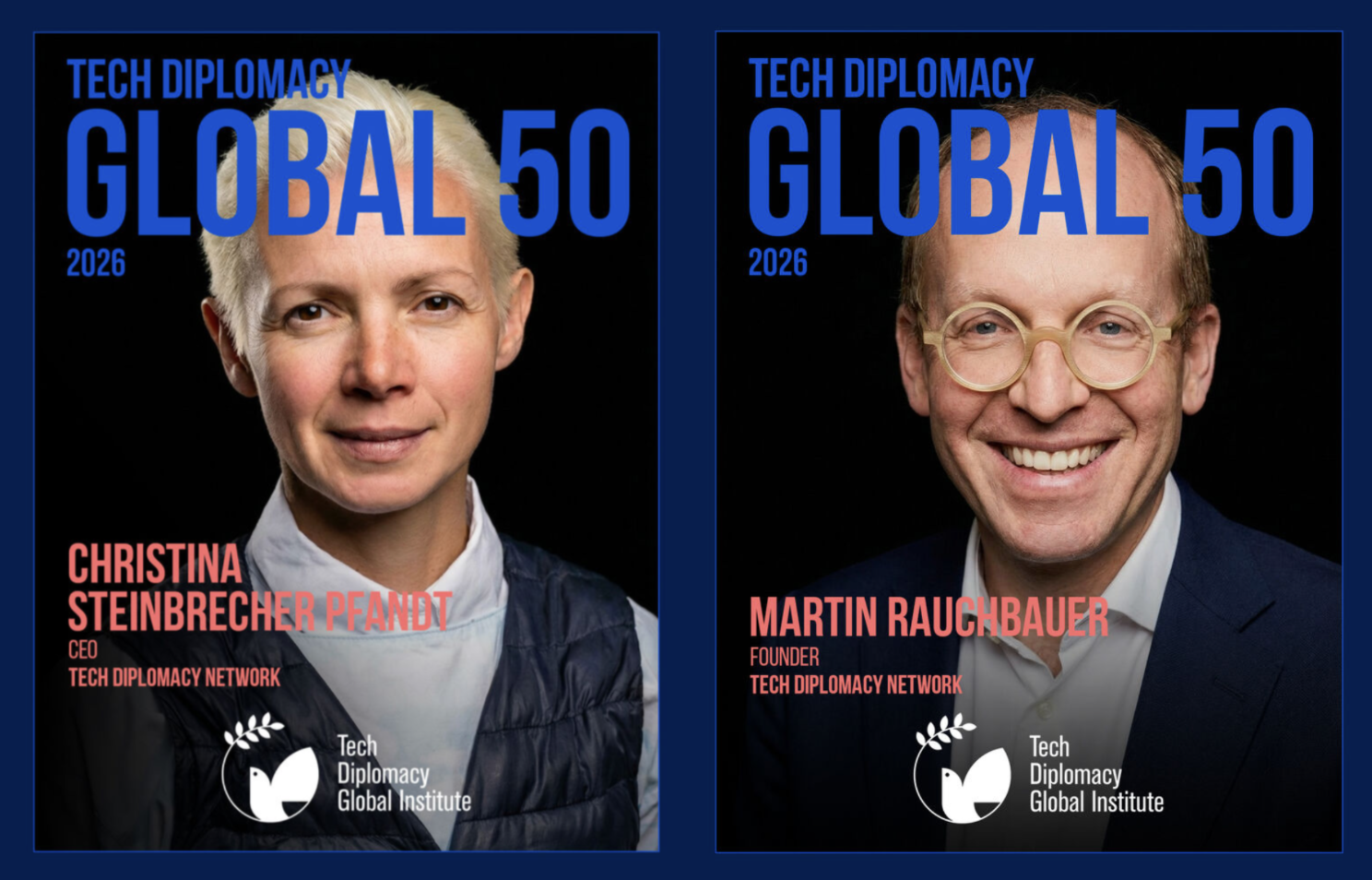
| We are pleased to announce that Tech Diplomacy Network’s Co-Director and Founder Martin Rauchbauer, and CEO Christina Steinbrecher-Pfandt, have been recognized amongst the world’s 50 most influential leaders in tech diplomacy by the Tech Diplomacy Global Institute. This group of individuals advances policy, digital governance, and international cooperation, and encompasses ministers, ambassadors, civil society leaders, UN officials, and more across five continents. See the full list here. |
| Global Finance ministers from the G7 and other major economies met in Washington on Monday to discuss reducing dependence on rare earths from China, including setting a price floor and building alternative supply partnerships. Japanese Finance Minister Satsuki Katayama said there was “broad agreement on the need to swiftly reduce reliance on China for rare earths,” outlining approaches from labor standards to minimum price setting, while German Finance Minister Lars Klingbeil cautioned Europe must act independently, stating “neither complaining nor self-pity helps us, we have to become active.” The meeting comes as China dominates the supply chain, refining between 47% and 87% of copper, lithium, cobalt, graphite and rare earths, Maria Martinez and Kanishka Singh report for Reuters. At the United Nations last month, countries pledged a people first digital future with stronger safeguards for AI as the World Summit on the Information Society twenty year review concluded. Governments committed to closing digital divides, protecting human rights online, and improving data and AI governance, especially for developing countries. North America Over the past year, America’s leading AI labs quietly reversed course on military use: OpenAI dropped its ban and partnered with Anduril, Meta opened Llama to defense customers, Anthropic teamed up with Palantir, and Google rewrote its AI principles to permit weapons-related work, a shift reflecting ballooning AI costs, Pentagon funding, and rising U.S.-China competition, Nick Srnicek writes for WIRED. The use of AI to generate sexualized and nonconsensual imagery targeting women is accelerating far faster than regulators can respond, experts warn, as a sprawling ecosystem of nudification apps, jailbreak guides, and distribution channels continues to thrive across mainstream platforms. Researchers say the result is not just individual abuse but a chilling effect on women’s participation online, with AI becoming “simply new ways to harass and abuse us and try and push us offline,” Helena Horton, Aisha Down, and Priya Bharadia write for The Guardian. A New Jersey lawsuit against a sexualized deepfake imagery-generating app underscores how difficult it remains to hold AI platforms accountable for non-consensual and abusive imagery, even when the content is clearly illegal. While individual users can be prosecuted, globally distributed platforms and general-purpose AI tools like xAI’s Grok sit in a legal gray zone shaped by jurisdictional hurdles and First Amendment protections. U.S. President Donald Trump said Microsoft has agreed to cover higher electricity costs for its data centers so local residents are not burdened with rising power bills, and the company also committed to paying full property taxes and refusing local tax or energy-rate incentives as opposition to large AI data centers grows. The move reflects mounting political and community pressure to manage the environmental and cost impacts of AI infrastructure expansion. Google co-founders Larry Page and Sergey Brin are scaling back their California footprint, shifting dozens of LLCs to Nevada and expanding ties to places like Florida. The moves come as California weighs a proposed wealth tax on billionaires, prompting some of the state’s richest tech figures to quietly hedge or relocate. While Page and Brin still own homes in California, the filings signal a clear retreat from the state that originally made them wealthy, Ryan Mac, Theodore Schleifer, and Heather Knight write for The New York Times. Africa Uganda shut down the internet nationwide two days before its general elections, with the Ugandan Communications Commission telling telcos the measure was necessary to mitigate “misinformation, disinformation, electoral fraud, and related risks” as President Yoweri Museveni tries for the seventh time to prolong his 40-year tenure. Digital rights organization Access Now warned that “around the world, governments deploy internet shutdowns to interfere with election outcomes and undermine democratic participation,” noting Uganda has periodically tightened control over digital space ahead of elections since 2011, Damilare Dosunmu reports for Rest of World. Africa is moving quickly to shape an ethical AI governance model that blends global standards with local values, as governments race to harness AI’s economic potential while managing risks like bias, data sovereignty, and digital inequality. Regional frameworks from UNESCO and the African Union, alongside national strategies in countries like South Africa, Kenya, and Ghana, are positioning ethics, inclusion, and community-centered principles, but the challenge now is turning ambition into enforcement, as gaps in infrastructure, skills, and regulatory capacity threaten to slow responsible AI adoption across the continent, Kevin Mwangi reports for TechInAfrica. Amazon’s Project Kuiper has secured a seven-year landing permit from Nigeria’s communications regulator, clearing the way for satellite internet operations to begin in 2026. The approval positions Kuiper to compete directly with Starlink in one of Africa’s largest broadband markets, covering services for homes, enterprises, mobility, and critical infrastructure. Africa Tech Summit Nairobi has named 12 investor-ready African startups for its 2026 Investment Showcase, spanning fintech, AI, healthtech, climate, and Web3. The selected ventures will pitch to investors next month, aiming to secure funding, partnerships, and global exposure. Asia Qatar and the United Arab Emirates are joining Pax Silica, a U.S.-led initiative aimed at securing AI and computer chip supply chain. The two Gulf states would join Israel, Japan, South Korea, Singapore, the U.K., and Australia in what the U.S. Under Secretary of State for Economic Affairs Jacob Helberg has called a “coalition of capabilities,” bringing massive sovereign wealth funds, cheap electricity for power-hungry data centers, and strategic location along the India-Middle East-Europe Corridor, Indranil Ghosh reports for Rest of World. Taiwan’s intense expansion of offshore wind energy to power its semiconductor industry is devastating coastal communities in Changhua county. Driven by a pledge to reach 20% renewable energy by 2025 and Taiwan Semiconductor Manufacturing Company’s commitment to run on 100% renewable energy by 2040, the semiconductor sector’s power demand is expected to grow eightfold by 2028, likely causing even more challenges to these communities. German Chancellor Friedrich Merz capped his first visit to India with a stop in tech hub Bengaluru, highlighting deepening tech and trade ties as Berlin looks to strengthen partnerships beyond the U.S. DW reports the visit comes just weeks before a planned EU-India summit and a long-awaited free trade agreement, with Merz praising India’s role as a hub for German industry and innovation. South Korea’s landmark AI law is set to take effect next week, but doubts are mounting over whether it can meaningfully curb deepfake offenses linked to tools like xAI’s Grok. While the law requires labeling and watermarking AI-generated content and applies to foreign operators, enforcement is delayed by a grace period and limited penalties, and legal experts are warning the framework alone is lacking. Pakistan has signed a memorandum of understanding with SC Financial Technologies, a firm linked to the Trump-associated World Liberty Financial crypto project, to explore cross-border payments using a dollar-backed stablecoin. The deal would involve technical cooperation with Pakistan’s central bank to assess how the USD1 stablecoin could operate within a regulated payments framework alongside the country’s digital currency plans. Europe U.K. technology minister Liz Kendall has backed Ofcom’s investigation into X after the Grok chatbot generated sexualised imagery, calling the recent content “deeply disturbing.” Reuters reports Kendall urged the regulator to move quickly, warning that victims and the public “will not accept any delay.” The Trump administration is increasing pressure on the EU to roll back regulation of US tech giants, setting up a clash that could spill into broader trade talks. Washington is framing Europe’s digital rules as “censorship,” backing Silicon Valley as Brussels fines and probes firms like Meta, Google, Apple, and X under the DSA and DMA. EU officials say they won’t be “bulldozed,” turning tech regulation into a geopolitical fault line in the transatlantic relationship. However, EU watchdog groups are now warning that the European Commission’s proposed tech “simplification” package reads like a wish list from U.S. tech giants, particularly when it comes to loosening data protection and delaying AI rules. France’s market regulator says a growing number of crypto firms are still failing to engage with authorities as the EU’s MiCA licensing deadline looms, with around 30% of crypto companies operating in France without an EU licence neither applying for authorisation nor saying they plan to shut down before the June 30 deadline, prompting concern from regulators. Officials warn firms must either secure approval or prepare an “orderly wind-down” as Europe tightens oversight of the crypto sector. The European Commission is preparing a sweeping digital infrastructure push in 2026 aimed at reducing Europe’s dependence on U.S. technology across cloud services, chips, networks, and AI. The planned laws are framed as a bid for digital sovereignty, but are already sharpening tensions with Washington, which has warned of potential retaliation. European tech investment held firm in 2025, reaching 72 billion euros across more than 3.7k deals according to Tech.eu’s latest annual report, which provide detailed insight into the past year’s innovation landscape. Download it here. Latin America Brazil’s antitrust regulator has ordered WhatsApp to suspend a new policy blocking third-party AI chatbots from operating on the platform, opening an investigation into whether Meta is unfairly favoring its own Meta AI. Brazil’s CADE says the rules may constitute “anti-competitive conduct of an exclusive nature,” echoing similar probes already underway in the EU and Italy. Latin American startup funding climbed 14% in 2025 to $4.1 billion, Crunchbase data shows, signaling a modest rebound even as investment remains far below the 2021-22 boom. Mexico drove much of the momentum with a 53% jump to 1.1 billion USD and the year’s biggest rounds, while Brazil still led overall at 2.1 billion USD. A growing feminist AI movement across Latin America is building tools to counter gender-based violence and reshape how technology is designed and governed. Activists and technologists are developing projects ranging from AI systems that apply a gender lens to legal analysis to apps that help women assess personal safety, arguing this approach benefits society as a whole, Silvina Molina reports for El País. AI is already reshaping classrooms across Latin America and the Caribbean, with 193 real-world initiatives now in use across 22 countries, according to a new report by the Inter-American Development Bank. Most projects focus on strengthening classroom learning and inclusion, but the next challenge will be scale and governance, as many initiatives lack rigorous evaluation and robust safeguards. Oceania A Papua New Guinean software developer has unveiled a prototype biometric voting appaimed at tackling election fraud, violence, and costly delays while modernizing government services. Australia’s recent push to rein in Big Tech offers a playbook for governments struggling to regulate powerful digital platforms, Bill Browne argues for The New Daily. From forcing Google and Facebook to pay for news to pioneering online safety enforcement and a controversial under-16 social media ban, the nation’s success in achieving public backing, credible enforcement, global coordination, and earning trust before trying to curb online power should serve as an example, Browne writes. Fiji has launched a nationwide universal service rollout aimed at extending internet access to remote and maritime communities, after regulators finalized delivery agreements with Digicel Fiji and Telecom Fiji Limited. The program seeks to connect hundreds of villages using satellite-based and managed Wi-Fi services, supporting education, healthcare, financial inclusion, and disaster preparedness across hard-to-reach areas. Meta says it has removed more than 544k under-16 accounts from Instagram, Facebook, and Threads in the first week of Australia’s ban, but the company is openly challenging the law’s effectiveness: Meta argues the ban creates a false sense of safety by pushing teens toward unregulated spaces and allowing algorithmic content to remain accessible without accounts, while Australian officials are standing firm, framing the crackdown as a necessary global test case. Guam has created an AI Regulatory Task Force, and local lawmakers say it will study issues ranging from privacy and data security to bias and workforce readiness, while shaping AI policy tailored to Guam’s cultural and economic realities. The advisory body is tasked with guiding future legislation so Guam can engage with AI “thoughtfully and ethically” rather than reacting to it after the fact, the Pacific Island Times news staff report. |
Follow our LinkedIn page to keep up to date on our upcoming events, publications, and efforts to foster collaboration and dialogue between the diplomatic community, civil society, and the tech industry. For more updates, stay tuned to the Tech Diplomacy Network! |